
A wedding speech
On pragmatism

Here is the wedding talk I gave at Aria Babu and Linden Schrecker’s wedding1.
The readings
There were two readings I’d requested, read by Lucinda and Henry:
Or suppose a king is about to go to war against another king. Won’t he first sit down and consider whether he is able with ten thousand men to oppose the one coming against him with twenty thousand? If he is not able, he will send a delegation while the other is still a long way off and will ask for terms of peace.
Luke, chapter 14, verses 31 - 32
Fred and George exchanged worried glances.
“I can’t think of anything,” said George.
“Neither can I,” said Fred. “Sorry.”
Harry stared at them.
And then Harry began to explain how you went about thinking of things.
It had been known to take longer than two seconds, said Harry.
You never called any question impossible, said Harry, until you had taken an actual clock and thought about it for five minutes, by the motion of the minute hand. Not five minutes metaphorically, five minutes by a physical clock.
Harry Potter and the Methods of Rationality, Chapter 25
Talk
There are four talks today and frankly I feel sorry for the others. I’m talking about pragmatism, good decision making. What could be more applicable for marriage? What else could you want to talk about? This is the whole shebang. The entirety of the law. I guess they’ll do what they can.
When preparing for this talk, I was struck by how much good decision making matters to Linden and Aria.
First because on one of the most important days of their life, they’re giving 7 minutes to it. There are 100s of you, that’s 700 minutes, so 10 or so hours of focus2. That’s a lot.
Aria talked about how when choosing a boyfriend, she’d really thought about the characteristics that she wanted in a good partner. She calculated how many such men existed in London, if any.
Aria talks about Linden’s traits in these terms, praising how he often asks “is there a better way of doing this”.
And when talking to Linden I was struck by how passionate he was. He talked about how he realised that one could make good decisions and that they would compound. And if I can be so bold, it’s worked. That if one makes good decisions for 5 years, one can be in a materially better place.
He used to have a thinking hour every Thursday where he just thought about how things could be better. I think this is more radical than it seems.
So I want to talk about good decisions:
Better decisions are possible
Decision making is hard
One decision making tip
Good decisions are possible
I would argue that almost everybody lives as if they believe that changes are possible. People give advice, they try and find better jobs, better holidays, better outcomes.
This isn’t new either. People are always giving advice in historical text, sometimes in specifically decision-theoretic terms. E.g. the first quote was by noted decision-theorist Jesus Christ. He is using an example people understand. Surely a king would consider whether he would win or lose before he fights a battle.
Even people who think there is no free will make decisions. Whether that’s the religious determinists or scientific atheists, and I know some of each. All are choosing what to cook, who to hang out with, how to educate their children. I can’t recall ever having met someone who acts as if decisions don’t matter.
But this takes us to our second point, good decision making is hard.
Because lurking beneath the acknowledgement that people can make good choices is that they can make bad ones too.
I have had years where I didn’t want to face up to things going wrong in my life. I guess you have too. I didn’t want to face up to that responsibility.
And I guess that’s why many people keep decision making in a box, for their finances, or board games. Because it’s scary to acknowledge they could make better decisions about their job or any large aspect of their life. They still can. You can in this moment decide to shift how your life works. You can make better decisions, even though it’s hard.
Waiting can feel like it allows more time for decision, but really it’s a kind of decision itself. I have missed a number of opportunities due to waiting. Sometimes it’s better to jump.
And I think we see a little evidence of good decision making here. Sure, Aria and Linden have been lucky, in where they were born and their immutable qualities. But they’ve made good choices in their jobs, their friends and choosing each other. But I think they’ve also made good choices.
So finally, a tip. Spend 5 minutes thinking about it.
Aria is a fan of the rationalist writers, and the second reading was from their canon. A Harry Potter fan book, where rather than being a mysteriously well-adjusted orphan, Harry is a mysteriously confident nerd. But he has some good advice
In the reading Fred and George (they exist in this story) are struggling to make a decision.
And one piece of advice is that to think about something, you have to actually try. You should take 5 actual minutes by an actual clock. Or sand timer.
[At this point I revealed a sand timer that I use]
So there you go. So that’s my advice. When I feel the anxiety of a big decision. Take 5 minutes to think about the decision and only the decision. I write down as many as I can think of and think which is best3.
It’s easy to go with the easiest choice (which is often waiting) but even 5 minutes of focused thought is much better than my snap decision.
Perhaps that helps.
If you have a big decision perhaps talk to someone over lunch4.
And so that’s my talk. One, better decisions are possible. Two, often the hardest thing is facing that fact. And three, perhaps spend five minutes thinking about the question at hand. At least, if someone asks, you’ve really spent 5 minutes.
If everyone did that, I think the world would be a better place.
Thank you for listening.
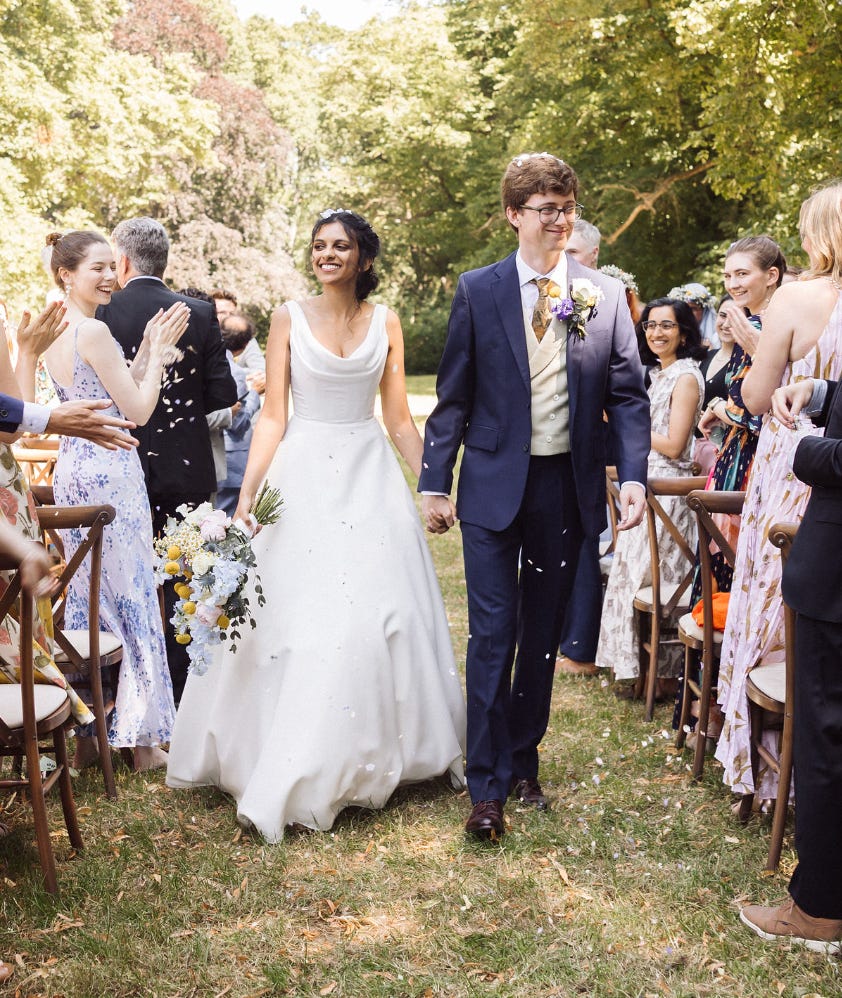
It was one of four short talks during the ceremony. It was a good format for an atheist ceremony, making clear what the couple wanted for their marraige.
I think is a good general way to think about speeches
It’s amazing how strange this can feel. When I’m struggling with a problem (or even a computer game), if I write down the features and options, often it’s easier to think about.
This speech is actually a toned-down version, the original had a minute of focused thinking.
Nice work, Nathan. This type of writing tends to suffer from reporting bias: people report the stuff other people got right. Could we have a couple of examples where you or people you know (and who don't mind being quoted) put a lot of time and effort into decisions that didn't work out and then try to spot the patterns there?
I think this is a really important area. Thank you for raising it. I want to write something on your article on prayer, too. I think I'll call it 'Why the atheists aren't entirely wrong about prayer.'
Love from Dad